
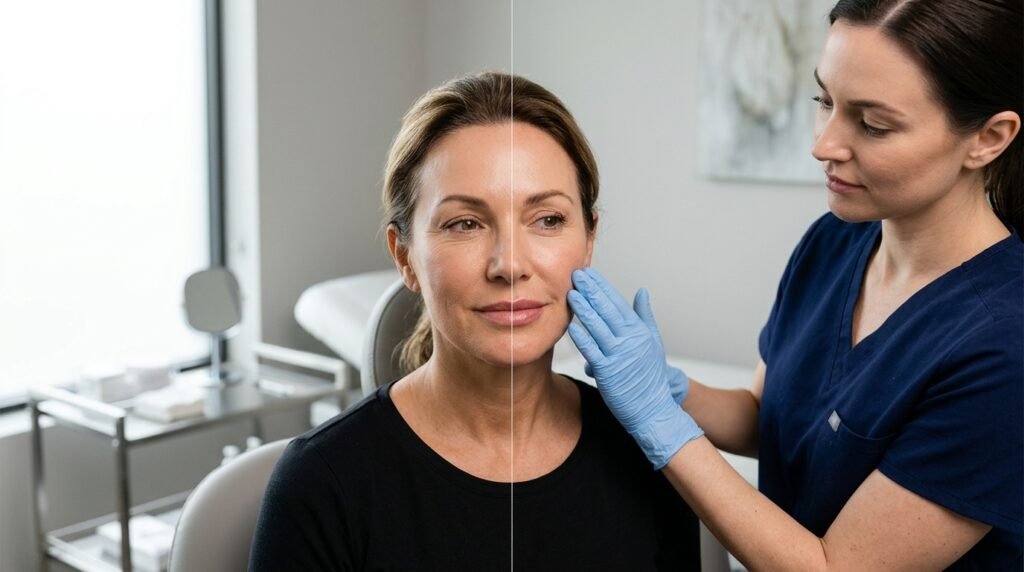
Choosing between Botox and fillers can feel confusing because both are injectable treatments, but they do very different jobs. Botox softens lines caused by muscle movement. Fillers add volume, shape, or support under the skin. The best choice depends on what you want to improve, where the concern sits, and what is causing it. A trained provider can help you decide on a face-first plan, not a trend-first plan.
Botox and Fillers Treat Different Face Concerns
Botox is a neuromodulator. It relaxes small facial muscles that create lines when you smile, frown, squint, or raise your brows. It is often used for forehead lines, frown lines, and crow’s feet. Fillers work in another way. They sit under the skin to restore lost volume, shape the lips, soften folds, or support areas such as the cheeks and chin. The American Academy of Dermatology notes that fillers can last from a few months to several years, depending on the filler type and the area treated. Botox Cosmetic labeling says its effect for frown lines is about three to four months. So, when comparing Botox vs fillers, the real question is not which is better overall. It is which one matches your exact concern?
When Botox Is the Better Choice
Botox is often the better choice when lines are caused by repeated muscle movement. Think of forehead lines that show when you raise your eyebrows, lines between the brows from frowning, or small lines near the eyes from squinting. These are called dynamic lines. Botox helps reduce the pull of those muscles, so the skin looks smoother while still keeping natural expression when placed well.
This is why Botox is often picked for upper-face goals. It can help with forehead lines, frown lines, crow’s feet, and a small brow lift effect. It does not add fullness. It does not fill hollow areas. It also does not change skin texture in the way resurfacing treatments can. If your main goal is to soften movement lines, fillers vs Botox usually point toward Botox first. If your goal is lift, shape, or volume, Botox alone may not be enough.
When Fillers Are the Better Choice
Fillers are often better when the face has lost support or volume. This can happen in the cheeks, lips, temples, smile lines, chin, jawline, and under-eye area. Hyaluronic acid fillers are common because they can add soft volume and are often reversible with an enzyme called hyaluronidase. Other fillers, such as calcium hydroxylapatite or poly-L-lactic acid, may last longer but are not reversed in the same simple way.
People often ask, how long do dermal fillers last before they book. The answer depends on the product and placement. The AAD lists hyaluronic acid gel fillers at about four to twelve months, calcium hydroxylapatite at six months to one year, and poly-L-lactic acid at one to three years. Lip filler may fade faster because the mouth moves often. Cheek filler may last longer because it is placed deeper and moves less.
Botox vs Dermal Fillers for Under-Eye Goals
Under-eye concerns need careful thinking. If the issue is a hollow tear trough, dermal fillers under the eye may help by adding gentle support. But if the issue is puffiness, loose skin, dark pigment, allergies, or fluid bags, filler may not be the right answer. In some cases, under-eye filler can make puffiness look worse. That is why this area should be treated by someone with strong experience in facial anatomy.
Botox near the eyes is different. It is often used for crow’s feet, not deep under-eye hollows. Some people search for Botox vs fillers under the eye, but these treatments do not solve the same problem. Botox relaxes movement lines around the eye area. Fillers support hollow areas under the skin. A good consultation should check your skin, fat pads, cheek support, and facial movement before any product is chosen.
The Mirror Test: Match the Treatment to the Real Cause
A good way to think about dermal fillers vs Botox is to look at what happens when your face moves. If the line appears mostly when you smile, squint, or frown, Botox may be a better fit. If the line, hollow, or fold is there even when your face is still, filler may be more helpful. This is not a perfect test, but it gives you a simple starting point before your consultation.
Photos can also help, but they should be used with care. Real dermal fillers before-and-after photos should show balanced changes, not overdone results. Look for faces that still look like the same person. Good filler should support the face, not make every area bigger. Good Botox should soften lines, not remove all expression. The best result is usually not the most dramatic one. It is the one that fits your face naturally.
What Each Treatment Can and Cannot Do
Botox can soften movement wrinkles, help prevent some lines from getting deeper, and give a subtle lifted look in certain areas. Fillers can restore volume, shape lips, soften folds, and improve balance. Some fillers may also be used for scars in select cases. For example, dermal fillers for acne scarring may help lift certain depressed scars, but not every acne scar type responds well to fillers.
Here is a simple way to compare them:
- Botox works best for movement lines
- Fillers work best for volume loss and shape
- Botox usually lasts about three to four months
- Fillers may last months to years, based on the type
- Botox does not add volume
- Fillers do not relax muscle movement
- Some plans use both for a more balanced result
Botox vs Fillers Side Effects and Safety
Both treatments can cause side effects, even when done well. Botox side effects may include mild bruising, swelling, headache, uneven movement, or temporary heaviness if nearby muscles are affected. Filler side effects may include swelling, bruising, tenderness, lumps, or unevenness. The FDA says the most common filler side effects happen soon after injection, and many settle within days to weeks, but delayed problems can happen.
More serious filler risks are rare, but they matter. Filler injected into or near a blood vessel can cause serious harm, including skin injury or vision problems. This is one reason cheap treatment from an untrained person is not worth the risk. When comparing Botox vs fillers side effects, fillers often carry more anatomy-related risk because they add material under the skin. Botox also needs skill, but the safety concerns are different.
Which One Gives More Natural Results?
Natural results come from the right product, the right dose, and the right placement. Botox can look very natural when your provider keeps some movement and avoids over-relaxing the face. Fillers can also look natural when they are used to restore support instead of adding too much volume. A small change in the right area often looks better than a large change in the wrong area.
The most natural plans often use less than people expect. A provider may suggest Botox for the upper face and filler for cheek support or lips. They may also say you do not need one of them yet. That is a good sign. A careful injector does not push every treatment on every face. In the botox vs dermal fillers choice, the safest answer is the one based on your anatomy, not a social media photo.
Cost, Maintenance, and Long-Term Planning
Botox is often priced by unit or treatment area. Fillers are often priced by syringe. Botox may cost less per visit, but it needs more frequent upkeep. Fillers often cost more in one visit, but the result may last longer. The final price depends on your location, provider skill, product type, and how much correction is needed.
Long-term planning matters more than chasing the lowest price. If you get too much filler too often, the face can look heavy or puffy. If Botox is placed poorly, brows can feel low, or expression can look stiff. A good provider will plan timing, dose, and maintenance so your results age well. Ask what will happen after three months, six months, and one year. That gives you a clearer view of the real cost.
So, Which One Is Better for Your Face Goals?
Botox is better for lines caused by muscle movement. Fillers are better for volume loss, hollowness, shaping, and some folds. Neither is better for every face. Many people get the best results from a careful mix of both, while others only need one treatment. The right choice starts with the cause of the concern, not the name of the product.
Before you book, ask your provider what they see, why they suggest that treatment, how long it may last, and what side effects are possible. A good consultation should feel clear, calm, and honest. When the plan matches your face, the result can look fresh without looking forced.